Hej, vi vill bara kolla att du är gammal nog
Den här webbplatsen innehåller information om alkoholhaltiga drycker och riktar sig till dig som är över 25 år
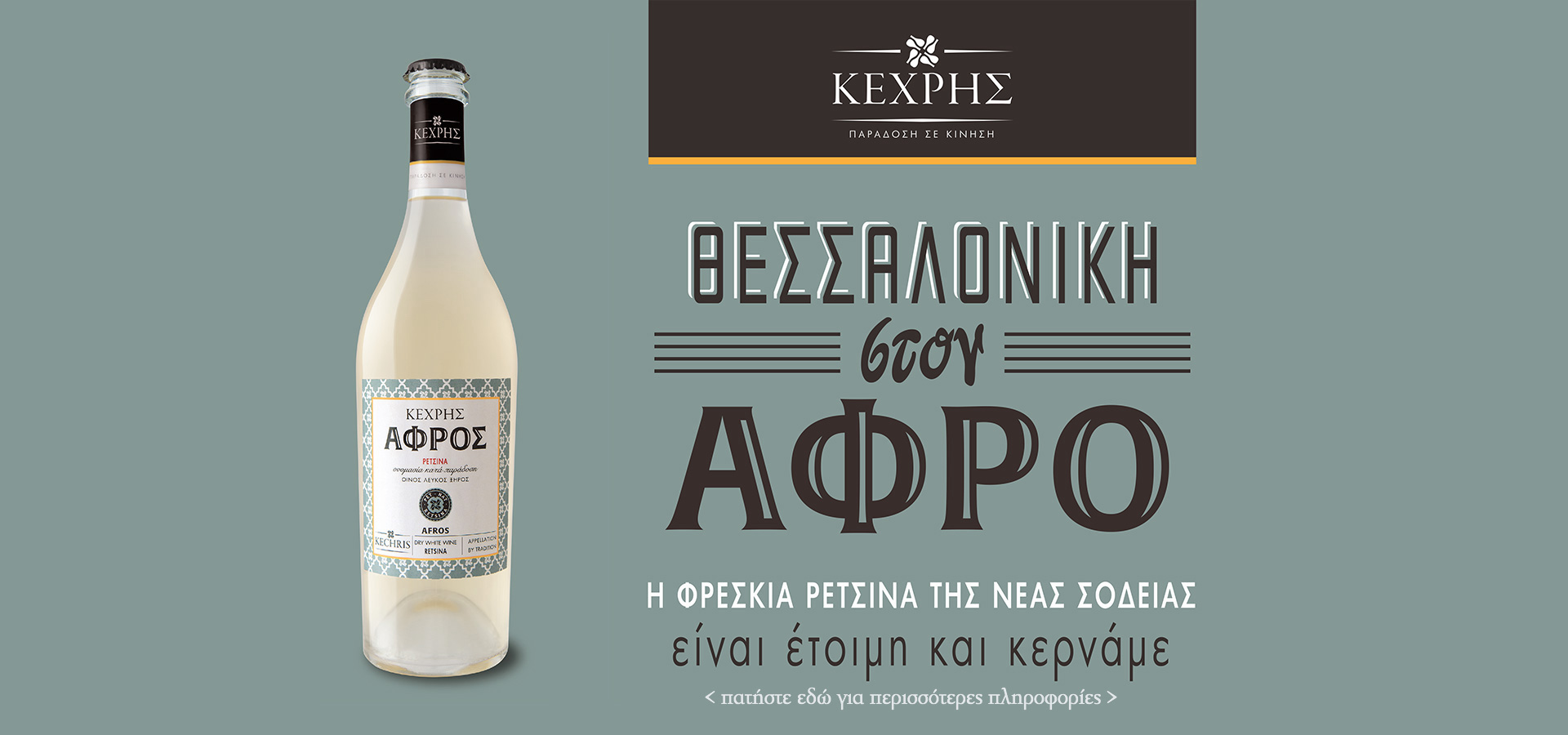
AFROS. HOW STELIOS KECHRIS’ MEMORIES BORN THE FIRST «SPARKLING» RETSINA
”When I was a 15-year-old middle school student, my uncle Christodoulos—one of my father’s three brothers—would take me along with him to Southern Greece in search of grape must. It was there that I witnessed firsthand the winemaking process and the sacred ritual—because in my young eyes, that’s exactly what it was—of washing the wooden barrels on the waterfront with saltwater, filling them with fresh must, loading them onto patiently awaiting wooden caiques, and watching them set sail for the port of Thessaloniki.
Our family, originally from Kymi on the island of Evia, settled in Thessaloniki right after the War. In 1939, my father—the eldest of four boys—opened a tavern called ”Kokoras” (The Rooster) in the Kallithea neighborhood. Years earlier, at just 16, he had arrived in Thessaloniki to work for an uncle who ran a distillery. Three years later, he had saved enough to open his own tavern and bring his brothers over from Kymi. They were forced to make a life for themselves early: both parents had passed away before the war, leaving my father, at only 12, as the head of the family. As the oldest, he sought his fortune in a big city full of opportunities, leaving behind an impoverished countryside—a common path for many in post-war Greece.
In our tavern, nestled next to the city’s ancient Byzantine walls, guests were treated to good quality retsina and sweet, sun-dried wines. Our signature retsina was made from must transported from Karystos, Aliveri, and Santorini. Carrying must across such distances under harsh conditions using the humble transport of the era—primarily wooden boats—served two purposes: it filled the shortage of suitable raw materials for retsina in Macedonia at the time, and it nurtured a deep nostalgia for the homeland his brothers refused to sever ties with.
The Birth of a Legacy
Our wines, and particularly retsina, quickly gained a reputation. The tavern became a company under the name ’Afoi E. Kechri OE’ (E. Kechris Bros GP), and from 1954 onwards we began producing spirits in addition to wine: ouzo, brandy, and liqueurs. Thus, we started selling fermenting must to other taverns in Thessaloniki. By the mid-1960s—as I remember firsthand—we had placed around 700 to 750 of our own barrels, or ’bombes’ (as the barrels containing must were called back then) with a capacity of 300 to 500 okades, in various Local taverns.It was backbreaking work under challenging conditions. The caiques unloaded the barrels using winches onto long carts pulled by heavy Hungarian draft horses. Unloading from the cart to the tavern—if it sat at street level—required two long wooden beams forming a ramp, anchored by an empty barrel as a counterweight. If the tavern had a cellar, transferring the must meant using a manual piston pump.
The energy to move that liquid came from two people—a task I personally performed countless times—facing each other and working a long wooden lever back and forth to drive the piston. To make matters harder, the actively fermenting must, rich with trapped carbon dioxide, would often cause the pump to lose traction and ”run on air,” forcing us to push twice as hard.
That entire ritual on the pier, the physical struggle with the manual pump in humid cellars, and the lively must bubbling with trapped gas were not merely memories of hard labor; they were the birth of our winemaking identity.
Lessons from the Sea
When we transported those musts on open boats, watching the liquid cool naturally under the sea breeze day and night, we were living through our first real lesson in temperature control without even realizing it. That ”detail”—the cool Aegean breeze—is the exact mechanism we now carefully recreate in the modern winery to keep the wine vibrant and fresh.
And then, there was our big secret: just before alcoholic fermentation finished, we sealed the barrels tightly with cork, burlap, and plaster, locking the final release of natural carbon dioxide inside. On October 26th—St. Demetrios Day, when tradition called to tap the barrels—the retsina rushed out with violent energy, bursting with freshness and the crisp, clean aromas of pine resin. This was the authentic, freshly-tapped ”giomatari”.
AFROS: History Bottled Fresh
AFROS is the direct, natural reincarnation of that exact life experience.
It isn’t just a modern retsina; it is my deliberate attempt to capture that historic wooden barrel inside a bottle:
- Unfiltered and Naturally Cloudy: Bottled immediately after fermentation, AFROS retains its raw, hazy appearance—a homage to the traditional ”giomatari” and the authentic winemaking truth found at the bottom of the barrel.
- Naturally Effervescent: It traps the natural spark of carbon dioxide from fermentation directly in the bottle—just as we locked it in decades ago with burlap and plaster—giving the wine a vibrant, spritzy personality.
- An Authentic Sensory Experience: It offers the exact sensation I experienced countless times in my youth: explosive, fresh aromas of lemon, peach, and mastic resin, captured at the precise second the barrel tap was struck.
AFROS holds our entire journey—the wooden boats, the strain of the hand pump, and the warm nostalgia of the old neighborhood tavern. It is my personal life story, modernized, yet entirely faithful to its origins.”
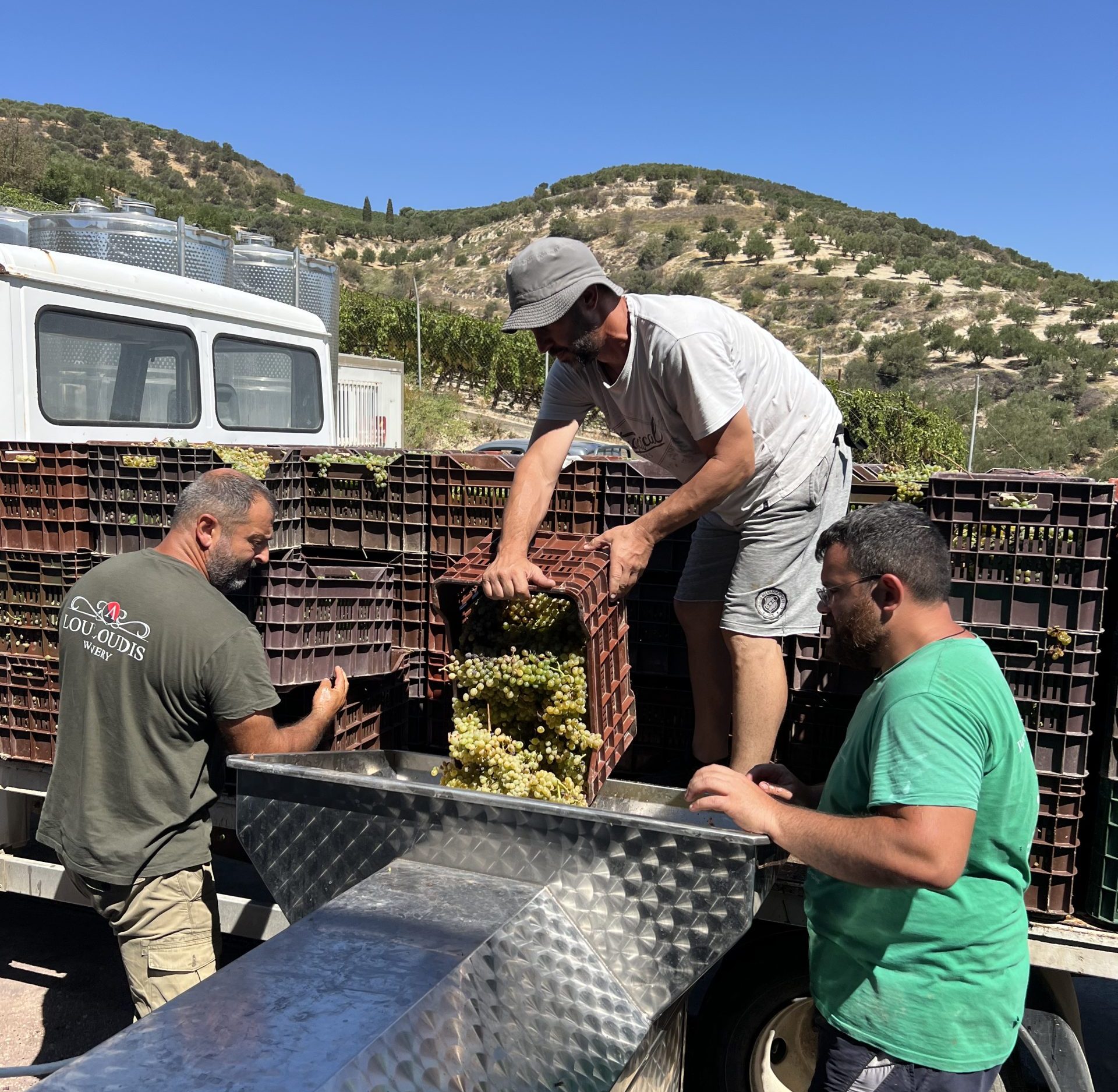
En nyhet i vår ”vinfamilj”
Vi välkomnar Louloudis Winery vars viner snart dyker upp till försäljning.
I den historiska regionen Dafnes på Kreta är vingårdarna belägna, och nu har familjen med Antonis, vinmakare i tredje generationen, flyttat hit för att på heltid ägna sig åt sin passion.
Med viner på druvsorter som Liatiko, Thrapsathiri, Muscat of Spinas och Kotsifali, för att nämna några, har familjen gjort sig ett namn utanför Greklands gränser.